
Archaeology, Mushroom Church, and Finding Poetry.
Part Three of Playing an Artifact Tabletop Game with Archaeologists
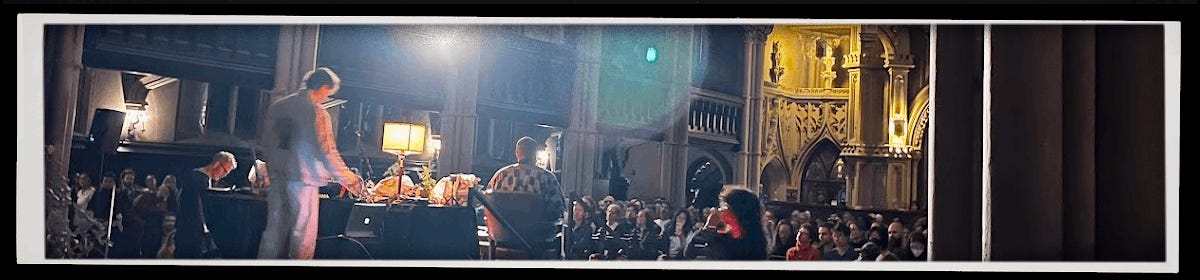
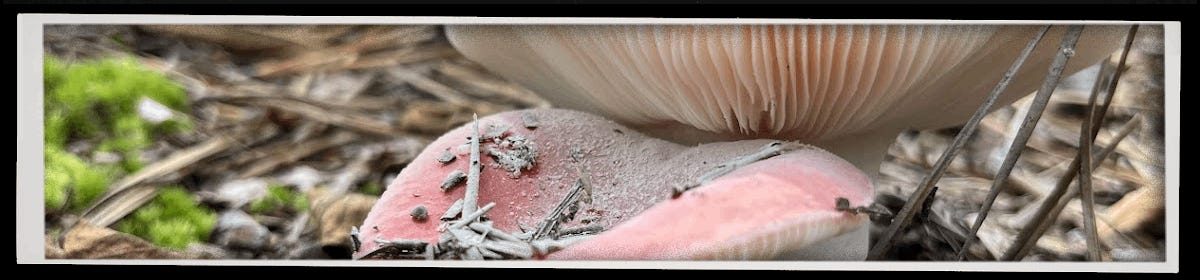
A couple weeks ago, the entire cathedral was full and completely silent in anticipation. Oyster Pleurotus, Chestnut, and overgrown Lion’s Mane mushrooms sat sacred on a table up front. They were connected to a plethora of synth cables adjacent to a saxophonist, and together created the following melody:
And this was Mushroom Church.
The event of course was silly, which is what brought most folks there. Yet, the people who came to be silly also showed up with focus and intention. They were also there to listen to poetry, to activism, and to the sonified murmurs of mushroom bioresistance. There was plenty of science and spirituality talk, with all of these interested New Yorkers spending their Saturday night enjoying the dialogue and soundscape.
This article marks the third and final installment of my To Care is to Cairn series. In part one, archaeologists used my tabletop game to explore meaning-making, contextual affordances, and new ways to relate to people of the past. Part two took this further, introducing the idea of terroir into the game: how people and their environments shape one another over time. Together, these sessions used silly play to bring archaeologists into thoughtful conversation, building a specific shared set of stories that were each shaped by the particular voices and experiences in the room.
Now, for part three, I want to explore how our shared place, strung together by symbolic activity and ritual, allow us to build something new.
Informed by historic play,
how does one find and shape their own Mushroom Church?
Digging into Games and Symbols
“Man has, as it were, discovered a new method of adapting himself to his environment. Between the receptor system and the effector system, which are to be found in all animal species, we find in man a third link which we may describe as the symbolic system. This new acquisition transforms the whole of human life.
…
No longer in a merely physical universe, man lives in a symbolic universe. Language, myth, art, and religion are parts of this universe. They are the varied threads which weave the symbolic net, the tangled web of human experience. All human progress in thought and experience refines upon and strengthens this net. No longer can man confront reality immediately; he cannot see it, as it were, face to face. Physical reality seems to recede in proportion as man’s symbolic activity advances. Instead of dealing with the things themselves man is in a sense constantly conversing with himself. He has so enveloped himself in linguistic forms, in artistic images, in mythical symbols or religious rites that he cannot see or know anything except by the interposition of this artificial medium.”
We are abstract organisms, and in the modern age we face abstract problems. One reason Margaret Atwood’s The Handmaid’s Tale creates such a haunting dystopia is that there is no tangible enemy to fight. One day members of the government are shot, soon credit cards stop working, and then new laws begin to appear daily. We are left with a frightening sense of nihilism that nothing can be done, because the foe is invisible and the weapons are powerful visages. It would be extremely hard for a community to come together in opposition, when it is unclear who and how they should be fighting.
What’s particularly interesting is that, through hosting games with archaeologists, I’ve found many of them to be remarkably active in their communities. I’ve been to a rally one ran security for, added writing to a newsletter another distributes through email chains, and couldn’t follow up with a third because their work was under threat from the current administration and had to focus energy towards that. They understand the power of our symbols but are not constrained by the abstract barriers in front of them.
After attending a meeting with the ACLU, an organization that defends and preserves individual rights and liberties through litigation, lobbying, and community education, and after speaking with many thoughtful people at said meeting, one theme was strongly consistent. If anything is going to change, people of course have to act together. To do that however, we need to build connections with those around us and hold sway. For that to happen, we must find ways to participate meaningfully in our communities. If you do this, you will care more and so will those you align yourself with.
You won’t know how to fight or build anything if you can’t find your company and tools.
Make eye contact and small talk. This is not just polite. It is part of being a citizen and a responsible member of society. It is also a way to stay in touch with your surroundings, break down social barriers, and understand whom you should and should not trust. If we enter a culture of denunciation, you will want to know the psychological landscape of your daily life.
— Twenty Lessons on Fighting Tyranny from the Twentieth Century
My claim is not that tabletop games or mushroom churches will dismantle systemic issues. What I do believe is that games and silly premises offer a meaningful tool for bringing people together that can help towards even this. They invite folks to step into different worlds and explore issues they might otherwise avoid, and they create a symbolic framework for engaging with powerful ideas.1
Here we can confront the symbols and forces that hold power over us, allowing for shared understanding and conversation that may reduce the influence of those same imaginary beasts in the real world. When I sit in the mushroom church I’m asked to imagine myself as a mushroom. When I play with archaeologists I ask us to care about our little town by the mountains.
Together with strangers we can choose to feel open and silly, and we then are able to open a bridge to poetry, resources, and actionable direction with this throughway.
It’s possible for you to create these intentional communities.
“You know, I struggled for years to get through Training. I had to work and pay my own way. Washed dishes, worked in kitchens. Studied at night, learned, crammed, worked on and on. And you know what I think, now?” “What?” “I wish I’d become a plant earlier.”
― Philip K. Dick, Piper in the Woods: A Collection of Science Fiction
Prehistory and Worldbuilding
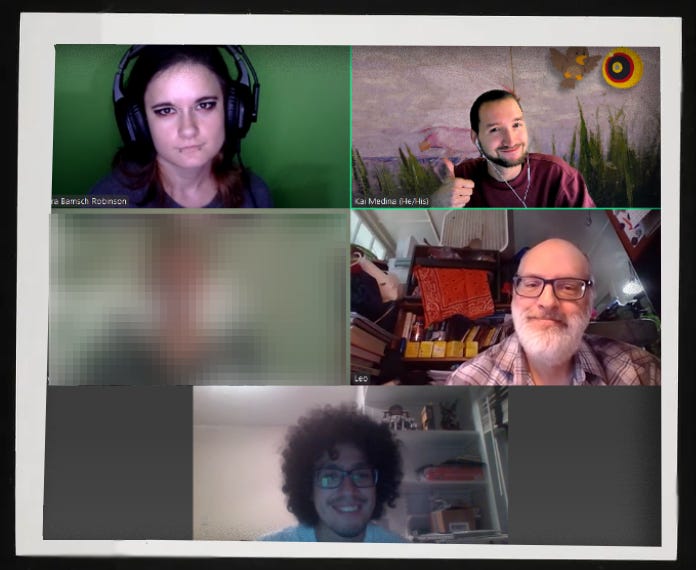
So, here we are creating once again and meeting with four new archaeologists. We played a tabletop game I put together called To Care is to Cairn that builds a township’s history through the lens of its shifting material record. While we played, I asked the group what experiences from their own lives they found themselves bringing into their work.
Braulio, Ciara, Leo, and one other participant (who wished to remain anonymous) were all strangers who joined my Zoom call and were introduced to two premises for their ancient society:
“The world is out there, and may one day come to bombard our concrete and canyons down. However, at least for now, the world is here. The world is our town.”
“We ascribe meaning to objects, so that their symbols may ascribe the same to us. It is now time to found our civilization.”
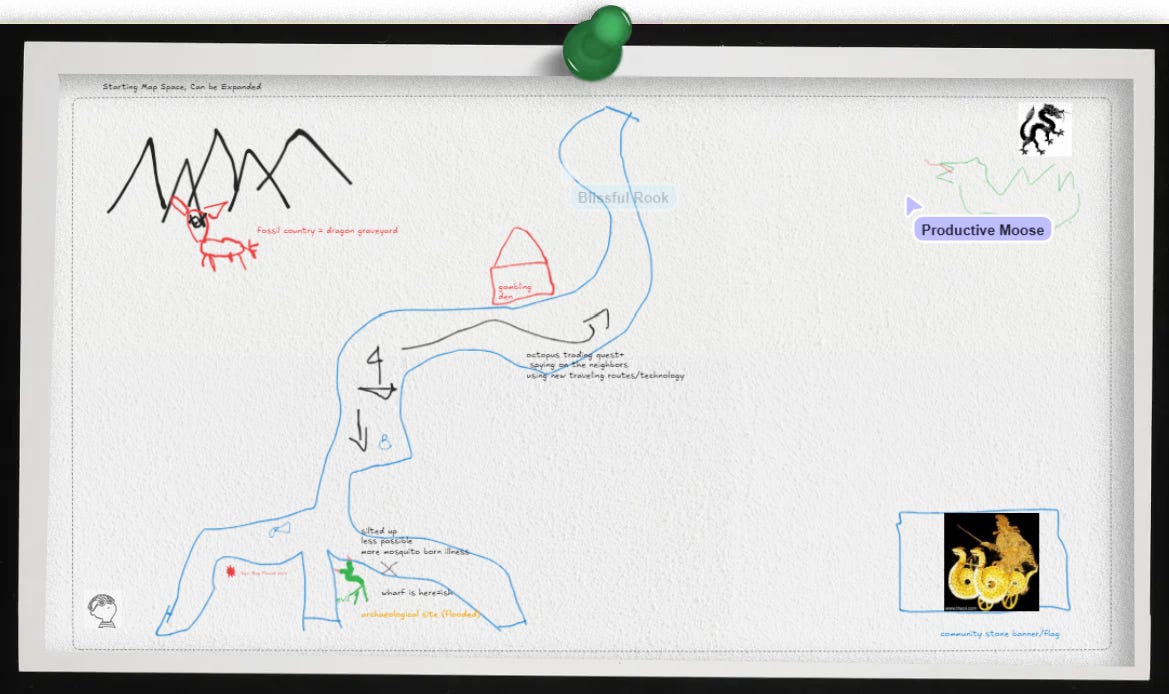
Utilizing prompts that followed these quotes, the group imagined a society organized around trade. Their township grew along a great river, its people navigating networks reminiscent of the Silk Road or the Mongol Empire. Commerce revolved around the exchange of rare materials from dragons, phoenixes, and other mythical creatures (regarded as wildlife rather than magic).
To understand how this society took shape, and how the players’ real-world disciplines informed it, we’ll move through each artifact they created.
And finally, to connect the serious and the silly in the spirit of a mushroom church, I present these stories as poetry, shaped from our game’s dialogue and influenced by the work of Margaret Atwood.2
“When the public becomes more involved, they gather more information about their legacy and challenge archaeologists to interpretations and findings…They would like for there to be less word of mouth communication of archeological events, as they would like to build a connection with communities, share different perspectives, and pass on potentially vital information to archeologists.”
― Nina Marie Diaz, Power to the People: The Community’s Role in Public Archeology
The Burned Doll
Small Finds
Quotes from the participant
Everyone’s favorites are small finds.
These are personal objects
that someone owns for themself.
Their toothbrush,
their doll,
their jewelry,
tons and tons of loom weights.
Athens didn’t have looms the way that we do, 3
they had a crossbar and they hung the strings from that.
The loom weights were clay,
or stone objects that held the warp threads steady,
so you could weave between them.
Those are my favorite small finds.
Older Weaves
Quotes from the participant and stories of my own
Jen had used loom weights
in the game,
at the school,
and after cleaning and working wool.
The participant found ancient splinter whorls,
twisting thread together.
Most of everything else was made of wood;
it wouldn’t have survived.
It’s an older style of weaving;
So, just imagine
Vikings sitting at the loom.
Richmond Coliseum
Quotes from Braulio, the participant, and references of my own
A traveling troops venue got struck by lightning.
Now the traveling troops had to perform open air.
Now it is always kept in open air,
like the Oddest Car Park in the World. 4
a site like that one that hosted figures
such as Elvis Presley,
Barack Obama,
and the Harlem Globetrotters.
The mayor shut it down,
claiming that it was
a burden on taxpayer dollars,
it’s stuck in limbo to this day. 5
I think the delta is silting up a little bit.
Ostia Antica
Quotes from the participant
Even before Rome ceased to be
the capital of the Roman Empire,
it was just unlivable.
There was the silting,
the constant epidemics,
trade was decreasing,
and it was less safe outside city walls. 6
In those city walls,
My doll had a full outfit,
evidence of how these people either used to dress;
wanted to dress,
or thought was appropriate for a doll.
I always hated Raggedy Ann dolls.
They’re a great example of how
no one dresses like that anymore.
But that doesn’t mean it isn’t still a style
someone in our society could
choose to wear.
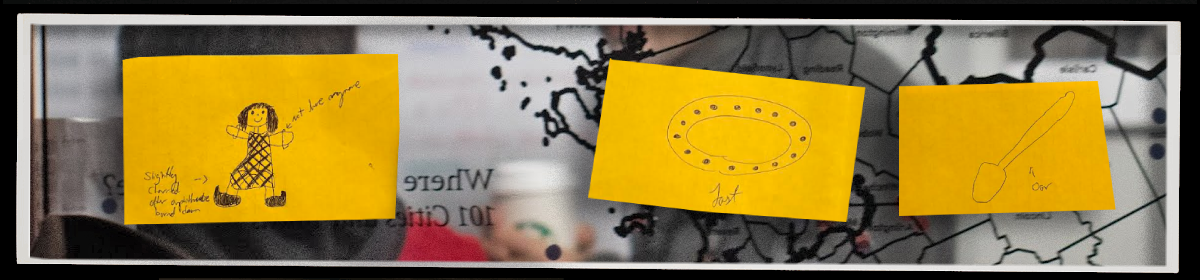
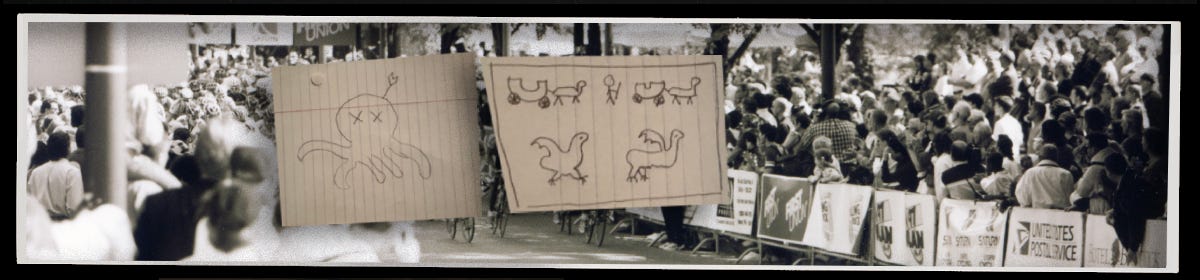
Octopus with an arrow through it
Merchants
Quotes from Braulio and the participant.
The ones who leave decide to become merchants.
They travel in and out of the town.
They trade in exotic animal materials.
The reason they became skilled at working
with dragon leather
is because they once made clothing
out of octopus material
but they eventually couldn’t anymore.
Yes, there are many animals that are considered taboo,
things people try not to eat.
But, when you’re starving,
you’re starving.
At Johnson’s Island,
there was a Union Army prison camp.
Confederate officers who took the Oath of Allegiance
were housed separately
and had a different dump site
from those who refused.
You can actually see,
in the archaeology,
that the ones who took the oath, repenting,
had normal food scraps.
The ones who refused were starving,
they ate rats,
squirrels,
birds.
The one animal that’s pretty much universally avoided across cultures
is the rat.
Rats are at the bottom of the food hierarchy.
People learned they carry diseases
and eat contaminated things.
Though,
as to the Confederate officers,
my sympathy for them is limited.
But For The Beak
Quotes from Braulio, Ciara, and Leo
The arrow would have completely decomposed,
but for the beak.
I think the dead octopus would have washed downriver,
The information lost.
They would know that it was used for hunting,
maybe it was really a harpoon.
In fragments,
a whole pot, bowl, or plate,
they’ll sometimes test to see if there are traces
of whatever was once inside it.
Food remains,
assuming the item hasn’t been scrubbed too carefully.
Test them for pollen
so we could see what people eat.
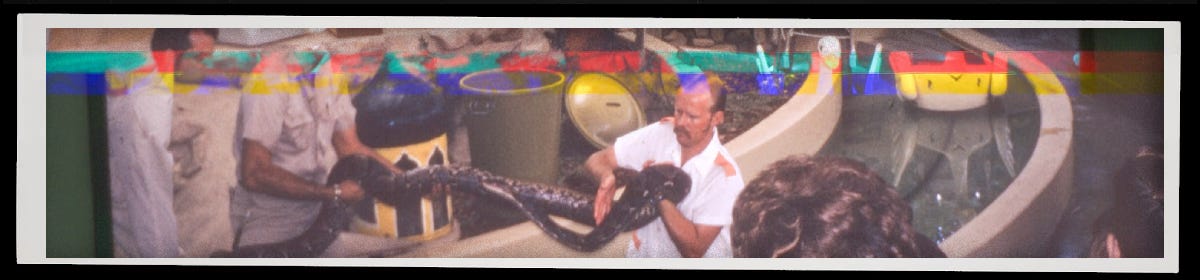
Understanding the serpent or the snake
was important to the town,
Whether or not it Comes across as being
a negative thing
or a positive thing
might be lost completely.
The arrow would have decomposed, but for the beak.
Pottery with squiggly patterns
“Don’t part with your illusions. When they are gone you may still exist, but you have ceased to live.” ―Mark Twain
Two-headed snake
Quotes from Ciara
The pottery, they used
had stamp patterns on it,
a little squiggly, almost like a snake.
The initial intention was just a pattern.
It didn’t really mean anything,
but whenever the disaster came through,
they never use this pattern again.
The pottery was passed down
from parent to child since then.
It’s only been 100 years,
and they’ve managed to not break it too bad.
Maybe all snake symbolism is bad?
and the pottery is buried
in the river silt.
If there’s frogs, there’s snakes.
Eviction
Quotes from the participant.
We would uncover the test units
and have to evict a copperhead snake.
The test unit was cool enough,
deep enough,
that once the snake got in,
it couldn’t get out.
We were out for the summer
looking for the old fort,
which we we’re never gonna find.
The guy who occupied the place afterwards
had the terrace raised
so that he could have a big, fancy house.
Hammer with Dye
Quotes from Ciara and myself
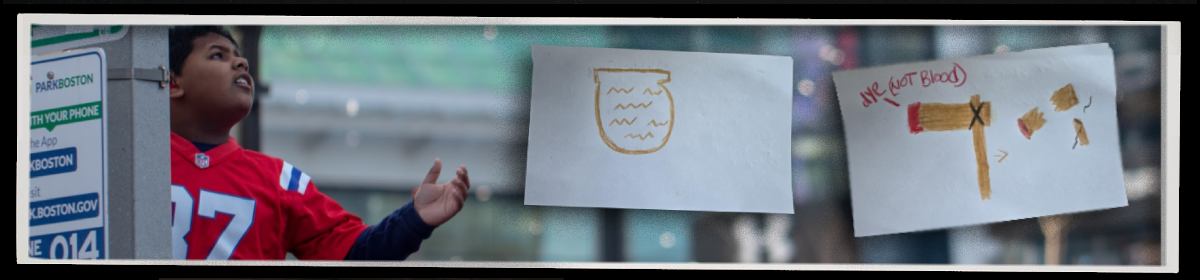
I think that I’m gonna discover a New Dye.
Maybe it’s made from a certain type of bug
a red dye.
A bug that’s attracted to prickly pear cactus plants,
A hammer they use to squish the bugs,
and you see…
there’s, like, a little red smudges on the edge?
Let’s see…
okay, so,
my little dye hammer.
This person got spooked,
and they thought they saw the ghost.
That’s fun.
This ghost, supposedly,
is the ghost of an old fisherman,
and it wants all your fish hooks.
It’s difficult to tread through,
in the river silt.
They swung it at them,
and it hit something and broke. So now—now…
Oh, the hammer’s—
—pieces.
Bird Bone Dice
King of Hearts
Quotes from Leo
Somewhere along the river,
there would be a den of ill repute,
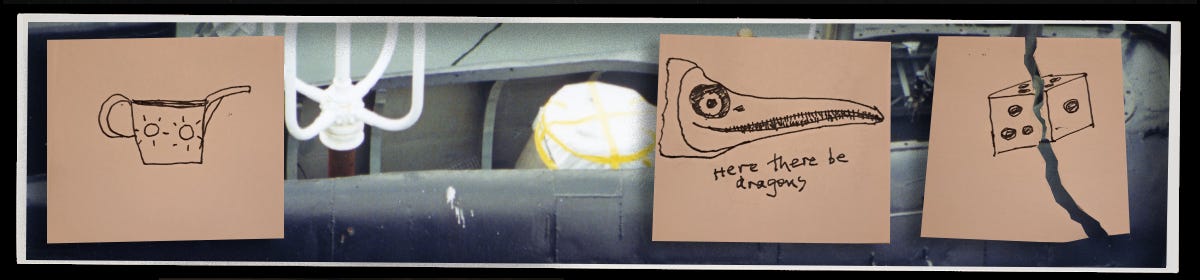
and there would be a die somewhere,
Somewhere along the way.
The pristine, bone dye,
from the rarest bird bone in this world,
fractured.
In Chinese sites in the West,
wooden dominoes survive.
They are tiny things that may have been part of a set,
but… people just maybe tossed or lost them in the dust;
dominoes and some gaming pieces.
They were taken,
punched out of tin cans,
made to service as items around a backgammon board.
They go back to the 1860s-1870s,
to Chinese work on the Transcontinental Railroad.
Some of them got curated for display
in one of the local history museums out here,
but… a lot of them… A lot of them are on a shelf somewhere,
in one… collection or another.
And, things like that.
The things that people use to pass the time
have gotten a fair amount of attention,
redefining the way we see other populations.
Ship Carving
The Financial District
Quotes from Leo, Braulio, The Participant, and myself
Tell me about a flood that ruined the archaeological site,
how they’re misinterpreting the lifestyle
of the previous landowners.
The flood swept through a part of the settlement
slightly below ground,
exposing areas of a building that hadn’t been known.
The flood goes through a part of what was once was the wharfs
and exposes ship timbers
suddenly present where there was only farmland before.
They found the hold of the ship
almost completely intact below the waterline.
There’s something carved in the timbers;
an icon of the sun.
It convinces them that their ancestry is based on that;
an icon that associates with the town,
so they feel that represents their ancestry.
The Aztecs in Tenochitlan discovered Teotihuacan,
they believed it was a city built by the gods,
because the Teotihuacan culture had already gone extinct.
Sometimes cultures will deliberately revive,
what is definitely their art, but then, it’s difficult.
Their, great-grandparents or whatever’s art,
traditional art styles or decorations,
Specifically to exploit tourist markets,
tourists want the stuff, and why not sell it to them?
There was also,
not too long ago,
After the 1906 earthquake,
the residents of San Francisco dumped a lot of the rubble into the bay
to create new land;
the Financial District. 7
a Gold Rush–era ship was found
excavating on dry land to build the foundation for a skyscraper.
rows of ships arriving with supplies for the Gold Rush,
building out this massive wharf system that stretched far
into what was then the bay,
which was later filled in
and built over.
A Military Engraving
Quotes from Braulio
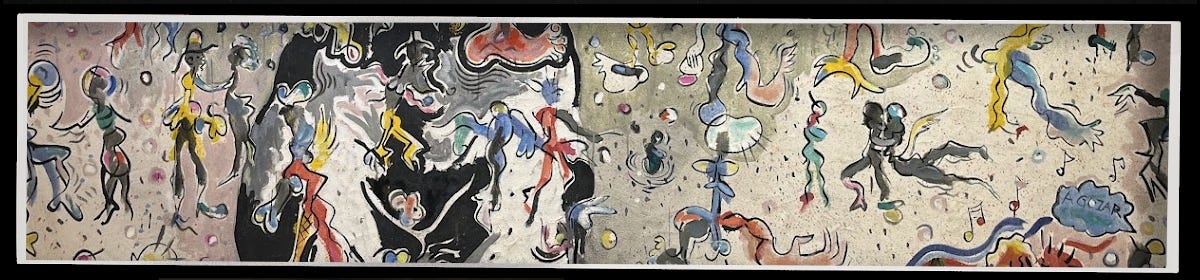
A stone banner is engraved with a depiction of their military,
the cavalry—just people on horses.
Some chariots too.
On the bottom row, a couple of dragons,
made to look like they’re
under the military’s control.
Standard of Ur and the Gates of Ishtar.
One row with the king, then the middle class, and the slaves.
The other completely blue,
with animals lined up in rows;
the impression that people could control beasts.
Final Reflections
These have been the poems and stories of archaeologists, facilitated through tabletop gameplay.
I am happy how three separate groups of archaeologists stepped into this odd little online space to play a game, and each one ended up creating something distinct and meaningful together.
Leo, at the end, reflected on how there’s “a lot of potential to use this kind of project to talk about archaeology in ways that don’t always get addressed when you’re learning from a textbook or in a course. It also opens space to connect personal experiences—things you, as an individual, go through—to what people in the past might have experienced … Role-playing gives you that ability to put yourself in someone else’s shoes. I really hope you try presenting it at some conferences, because it could be excellent outreach not just for professionals, but also for students and even kids.”
Ciara added in, “Honestly, my favorite thing is the collaborative play and building a world together. In archaeology, context is everything. A true understanding of whatever artifact you’re looking at has to come from the time, place, and culture from which it comes. I loved that each artifact we came up with was affected by game events in a way where we had to explain the how and why of its connection to the world we built: it’s context.
Working with real world material culture doesn’t tend to have the more fantastical elements that the game does, but I still have fun taking time to imagine the people who made it. Who made the pot this sherd comes from, and how did it break? We’ll never actually know the specifics, and that’s okay. It’s just something I enjoy doing. But interpreting an objects place in the lives of those who made it? That is an important part of real life and something that really came through in the game.
I like that we got the prompt of “how might your civilization wrongly interpret this archaeological site?” Because that happens a lot when you look at archaeology as a whole. People get things wrong, whether that’s because of a personal or societal bias, something being completely out of context, or just because someone missed something or made a mistake. It happens. In game, our civilization took a symbol from an artifact and decided it must have been theirs because it was similar to a symbol in their own culture. That happens in real life quite a bit.
I also enjoyed the setting we created together. The location our people lived in made sense in relation to where people settle in real life. When conducting archaeological research or field survey, looking at locations where people would have most likely lived in and around is important.”
So, remember to grow what you love and tend to a community. Create something specific and goofy, like a synthesizer plugged into a mushroom, then take it to a workshop to show others your joy. Finally, take that joy together, and keep growing something new. 8
Thank you for Caring to Cairn.
If you want more science related topics, check out and subscribe to my other blog The Holistic Scientist:
Credits
Participant information (such as name and position) was included in a fashion specifically requested by the individual. Participants additionally were provided an early draft version of the article to help correct for accuracy.
Unless otherwise noted, all images in this article were either maps and artifact cards from the game, photos taken by Kai Medina, or scans from originals photographs by his grandfather, Pierre Giroud.
Further Reading & References
I explore this in my article The Origins and Purpose of Science Fiction
I’ve been reading Margaret Atwood’s works Dearly, Morning in the Burned House: Poems, and The Door for inspiration. Additionally, if you want some stories on the interesting overlap between poetry and science, I recommend the podcast episode Theoretical & Creative Ecology by Ologies.
